
The Italy Golden Visa investment amount starts at €250,000. This is the Italy investor visa minimum investment, available through the startup route, and among the lowest entry points of the active European residency programs. The ceiling is €2 million. Four options exist under the program, each with a fixed statutory threshold, a different risk profile, and a different relationship between your capital and the Italian economy. None of them involve real estate.
Understanding what each route actually requires, and what distinguishes one from another beyond the headline number, is the first real step in deciding whether the program fits your situation.
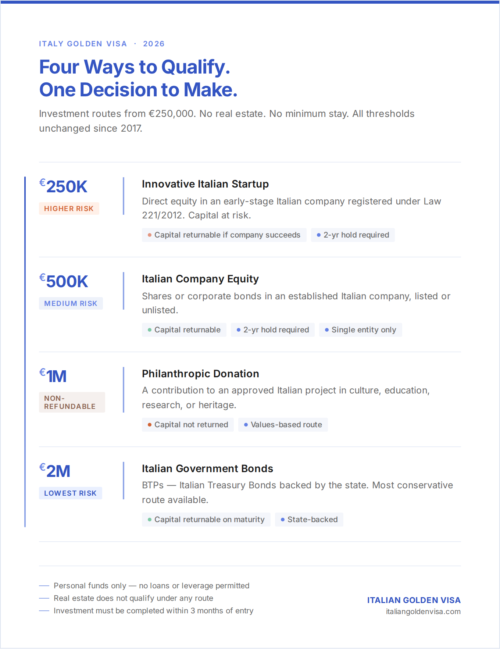
The Italy Golden Visa investment amount at a glance:
- €250,000: equity investment in a qualifying innovative Italian startup
- €500,000: equity investment in an established Italian company, listed or unlisted
- €1,000,000: philanthropic donation to a project of public interest
- €2,000,000: investment in Italian government bonds
- The current thresholds have been stable since 2020, when Italy halved the company and startup minimums to widen access to the program
- Investment must be made with personal funds; no loans or leveraged capital permitted
- Funds must be lawfully sourced, owned by the applicant, and available and transferable to Italy
- Full investment must be completed within three months of arriving in Italy
- Investment must be maintained for the duration of the permit to qualify for renewal
- Real estate does not qualify under any route
What Are the Italy Golden Visa Investment Options?
There are four investment routes. Each is a distinct legal category with its own qualifying criteria, not variations on a single theme. The route you choose at the Nulla Osta (the government’s preliminary approval) stage defines your investment structure for the duration of your permit. Changing routes later is possible, but it requires a new application process and fresh committee approval.
€250,000: Innovative Italian Startup
This is the program’s lowest entry point and its most accessible route. You invest directly as an equity holder in a qualifying Italian innovative startup, as defined under Law 221/2012 and Article 25 of Legislative Decree 179/2012. To qualify, the company must have been incorporated no more than five years prior, maintain its headquarters or a production site in Italy, generate annual revenues below €5 million from its second year of operation, not distribute profits, and must not be listed on any public stock exchange or trading platform. The official register of qualifying startups is maintained by the Italian Chamber of Commerce system.
The appeal of this route is the entry price. The complication is due diligence. An innovative startup, by definition, is an early-stage business. The investor is taking equity in a company with limited operating history and, in most cases, no guarantee of commercial success. The initial visa decision does not depend on the startup’s performance, but the capital does, and so does renewal: the investment must still be in place when the permit comes up for review, so a company that fails outright carries immigration consequences as well as financial ones. Investors who choose this route need to be comfortable with the nature of early-stage equity and should approach the company selection process with the same rigor they would apply to any direct investment.
€500,000: Italian Company
This route requires a minimum investment of €500,000. You invest directly in the shares or quotas (the ownership units of Italian limited companies) of an established Italian company, listed or unlisted, operating in Italy. The qualifying instruments are equity; corporate debt does not qualify. Collective investment vehicles and mutual funds, meaning structures that pool many investors’ money, also do not qualify under this route; the investment must go directly to a single company.
The tradeoff compared to the startup option is a higher threshold in exchange for investing in a business with an operating track record. Companies of meaningful scale, with revenue history and audited financials, are available to qualifying investors. Some investors work with partners who maintain relationships with established Italian businesses structured to receive this category of investment, allowing the capital to support real commercial operations in sectors where Italy has genuine economic depth: manufacturing, food production, design, and industrial heritage, among others.
€1,000,000: Philanthropic Donation
This route requires you to make a non-refundable contribution of at least €1 million to an Italian project of significant public interest, in areas including culture, education, scientific research, and heritage preservation. The key word is non-refundable. Unlike the equity routes, this capital does not return to the investor. There is no financial upside and no expectation of one.
Investors who choose this route typically approach it from a values-based standpoint: a commitment to Italian cultural or educational life that they would make regardless of any residency benefit. For individuals with a genuine connection to Italy and the means to treat the contribution as a philanthropic act rather than a financial instrument, it can be a coherent choice. Approached purely as the lowest total-cost route to residency, it is usually not.
€2,000,000: Italian Government Bonds
The government bond route requires a minimum investment of €2 million in Italian sovereign debt instruments, typically Italian government bonds known as BTPs (Buoni del Tesoro Poliennali). Qualifying bonds must have at least two years of life remaining before they mature at the time of investment. This is the most capital-intensive of the four options and also the most structurally conservative. The investment is backed by the Italian state, carries predictable terms, and offers the clearest exit path of any route once the holding period has been met.
For investors whose primary concern is capital preservation rather than commercial exposure, this route has a clear internal logic. The capital goes into Italian government bonds, which are liquid and backed by the state. The residency benefit is real and stable. The investor is not taking equity risk in a private company or making an irrecoverable donation. The cost of that security is the headline investment figure, which at €2 million sits significantly above the other three options.
How Do the Four Routes Compare?
| Route | Minimum amount | Capital returned | Risk profile | Best suited for |
|---|---|---|---|---|
| Innovative startup | €250,000 | Yes, if company succeeds | High | Investors comfortable with early-stage equity |
| Italian company | €500,000 | Yes, subject to company performance | Medium | Investors seeking established business exposure |
| Philanthropic donation | €1,000,000 | No | N/A | Philanthropically motivated investors |
| Government bonds | €2,000,000 | Yes, on maturity | Low | Capital preservation-focused investors |
What Are the Additional Costs Beyond the Investment Amount?
Beyond the qualifying investment, investors should budget for legal fees, government application costs, health insurance, and tax planning. The Italian Golden Visa cost picture extends well beyond the headline investment figure, and understanding the full range of expenses in advance avoids surprises.
Legal and advisory fees. A qualified Italian immigration lawyer is not optional on an application of this complexity. Fees vary depending on the firm and the route chosen, but investors should budget for professional guidance throughout the Nulla Osta process, the visa application, the residence permit filing, and subsequent renewals.
Government fees. Application processing fees, residence permit stamps, and related administrative costs are real, if modest relative to the investment thresholds.
Health insurance. Applicants must demonstrate valid health insurance coverage for Italy as part of the application. This is a requirement, not a discretionary expense.
Investment structuring and analysis. Investors choosing the startup or company equity routes will typically engage professionals to review and structure the investment. This is a separate cost from the immigration legal work.
Tax and financial planning. Investors intending to access Italy’s flat tax regime, currently set at €300,000 per year on all foreign-sourced income for new residents from January 2026 onwards, will typically engage a tax advisor to structure the move correctly. For investors relocating with family, the add-on is €50,000 per family member per year. See our guide to the Italy Golden Visa flat tax regime for a detailed walkthrough of how it applies in practice.
The total varies considerably depending on the route chosen, the complexity of the application, and the advisors engaged. Legal and advisory fees alone can range from €5,000 to €20,000. Tax planning, translations, notarization, banking costs, and travel should all be budgeted for separately.
What Are the Rules Around the Investment?
The investment must be made with personal funds, directed to a single entity, completed within three months of arriving in Italy, and maintained for at least two years. These are not administrative formalities; they affect the validity of the permit. The full process is set out on the Italian Investor Visa Committee portal.
Personal funds only. The investment must come from the applicant’s own resources. Loans, mortgages, and leveraged capital are explicitly not permitted. The funds must be lawfully sourced and available and transferable to Italy, and the committee conducts due diligence on their origin.
Single entity. The investment must go to one company or project within a single investment category. Capital cannot be split across multiple companies or combined across routes.
Three-month window. The investment does not need to be completed before arriving in Italy, but it must be finalized within three months of entry. This is a firm deadline.
Two-year holding period. The investment must be maintained for at least two years. Withdrawing or reducing the investment below the qualifying threshold before that point can result in revocation of the residence permit.
Renewal condition. To renew the permit after the initial two-year period, the investment must still be in place. The renewal process includes a committee review of investment compliance. Investors who have exited the position before the renewal window will not qualify.
Why Is Italy’s Golden Visa Investment Structure Different From Other Programs?
Italy’s program has never been built around real estate. When Spain closed its Golden Visa program in April 2025 and Portugal removed property as a qualifying route some years earlier, investors who had been waiting on the sidelines of property-led programs found themselves reconsidering Italy’s approach. Italy’s four routes, all productive economic investments rather than passive property holdings, position it differently from what most people imagine when they hear the term golden visa.
The program has also been structurally stable. The framework is grounded in primary legislation and has been administered consistently across successive governments since its 2017 launch. The only change to the thresholds came in 2020, when Italy halved the company and startup minimums to widen access, and the four routes have held steady since. For investors who weigh policy continuity alongside financial return, that track record matters. See our full comparison of Italy vs Portugal Golden Visa for a side-by-side look at how the two programs differ.
Frequently Asked Questions
What is the minimum investment for the Italy Golden Visa? The minimum Italy Golden Visa investment amount is €250,000, required for investment in a qualifying innovative Italian startup. The other routes require €500,000 in an Italian company, €1 million as a philanthropic donation, or €2 million in Italian government bonds.
Can I use a loan to fund my Italy Golden Visa investment? No. The investment must be made with personal funds. Loans, mortgages, and leveraged capital are not permitted. The funds must be lawfully sourced and transferable to Italy, and their origin is reviewed as part of the application.
Does real estate qualify for the Italy Golden Visa? No. Real estate purchases do not qualify under any of the four Italy Golden Visa investment routes. Only innovative startups, Italian company equity, philanthropic donations, and government bonds are recognized qualifying options.
How long do I need to hold my Italy Golden Visa investment? The investment must be maintained for at least two years, matching the initial permit period. If the investment is withdrawn before that point, the residence permit may be revoked. The investment must also remain in place to qualify for renewal.
Is the Italy Golden Visa investment amount refundable? It depends on the route. The startup and company equity routes involve capital that remains yours and can be exited once the holding period and permit conditions are met. Government bonds can be liquidated on maturity or once residency is no longer required. The philanthropic donation is non-refundable by nature; it is a contribution, not an investment.
Can I split my Italy Golden Visa investment across multiple companies? No. The investment must go to a single entity or project within one investment category. Capital cannot be split across multiple companies or combined across different routes.
If you are weighing which route fits your situation, talk to us and we will walk you through the tradeoffs.
The rules governing the Italian Investor Visa, including investment thresholds and qualifying routes, are subject to change. This article reflects the program as of August 2026. Consult a qualified Italian immigration advisor before making investment decisions.