
Key takeaways
- The Italian Golden Visa requires Committee approval before any capital is committed, so the file’s quality at submission determines the outcome.
- An Italian Golden Visa lawyer earns its fee primarily on dossier preparation, sworn translations, and source-of-funds framing.
- The Committee aims to review a complete file within 30 days. Errors typically trigger a request for more information rather than a clean rejection.
- Application support typically runs €8,000 to €15,000 for a single applicant. Annual compliance runs €3,000 to €10,000.
- Self-managing is workable for clean single-applicant cases. Families, layered structures, and complex source-of-funds situations effectively require legal counsel.
The Italian residency-by-investment route, formally the Investor Visa for Italy, looks straightforward on paper. Choose a qualifying investment, secure approval, deploy the capital, collect a residence permit. Investors who have read a few pages on the programme often arrive at a reasonable question. Do I really need an Italian golden visa lawyer for this, or can my existing advisors handle the paperwork?
In most cases, yes. The Italian programme requires a complete file to clear an inter-ministerial Committee before any capital is committed. The quality of that file at submission shapes almost everything that follows. Self-managing the paperwork is workable only for a narrow set of cases, which the sections below walk through.
The fuller answer depends less on the difficulty of any single step, and more on how the Italian system is built. Italy’s programme follows a strict sequence, and small errors are expensive. Capital is only committed after the state approves the file. A flawed application is therefore paid for in time and lost momentum, while the investment itself stays uncommitted. Legal counsel earns its place by reducing the mistakes that quietly extend timelines and erode trust with the Committee.
The Italian Programme Has a Specific Sequence That Rewards Preparation
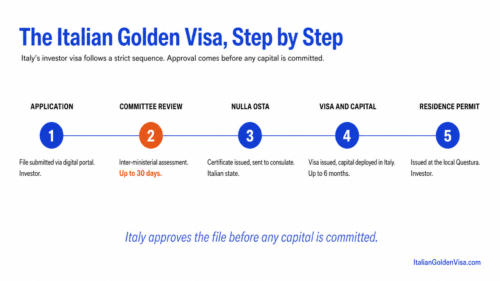
Most residency programmes ask for capital first and issue a permit later. Italy reverses that order. The investor submits a complete file to the Investor Visa for Italy Committee, an inter-ministerial body that reviews applications through a dedicated digital portal. The Committee aims to assess a complete file within 30 days. If approved, a Nulla Osta, or certificate of no impediment, is issued and sent to the Italian consulate of jurisdiction.
Only after that does the visa stage begin. The investor then has six months to apply for the visa, enter Italy, and deploy the qualifying capital. Four investment routes qualify:
- €250,000 in an innovative startup
- €500,000 in an Italian limited company
- €1,000,000 in a philanthropic donation
- €2,000,000 in Italian government bonds
This sequence has two practical consequences. First, the quality of the file at the Committee stage shapes the outcome at every later stage. Second, an incomplete file triggers a request for more information, a 30-day clock to respond, and a process that begins to build up delays. A lawyer’s role at this stage is structural. They prepare a file the Committee can approve on first read.
What Does an Italian Golden Visa Lawyer Actually Do?
An Italian Golden Visa lawyer prepares and submits the Committee dossier, manages the sworn-translation and apostille chain, frames source-of-funds documentation in language the Committee expects, and coordinates with the consulate and local Questura through the visa and residence permit stages.
Italian bureaucracy is exacting. Names, dates, and addresses must match across documents from several jurisdictions. Police certificates, financial records, and proof of where the funds came from must each be apostilled, translated by a sworn translator, and presented in the format the Committee expects. The Committee reviews more than the investor. The investment vehicle, the entity structure, and in some cases the source of wealth itself also come under scrutiny.
A capable Italian immigration lawyer does several things a translation agency or general advisor cannot. They draft cover letters in Italian that frame the investment in language the Committee understands. They spot documentation gaps before submission, while those gaps are still solvable. They coordinate with the consulate during the visa stage and with the local Questura during the residence permit stage. They tend to know which Questura offices handle investor permits efficiently and which create avoidable friction.
There is also the matter of judgment. An experienced lawyer will tell an applicant when a proposed fund or vehicle is unlikely to clear Committee review, before any capital moves. Some funds, such as Ariete Capital, are built to meet Committee criteria, with audited reporting and fund paperwork prepared to withstand scrutiny. Others are less prepared. A lawyer who has guided dozens of applications will see the difference quickly.
Why Do Most Italian Golden Visa Applications Get Delayed?
Most Italian Golden Visa delays trace back to the paperwork chain rather than the underlying merits of the case, and specifically to errors in apostilles, sworn translations, and the validity period of police certificates.
In conversations with investor visa lawyers in Milan and Rome, the same observation comes up. The apostille and sworn-translation process is the most common point of failure. Three problems come up again and again:
- A misnumbered apostille
- A police certificate issued more than six months before submission
- A translation that uses a financial term incorrectly
Each one can stall an application for weeks while the Committee waits for supplementary material.
These are not exotic issues. A serious investor would never accept this kind of detail in a corporate transaction. An Italian lawyer, working with a coordinator in the applicant’s home jurisdiction, can prevent these problems before the file ever reaches the Committee portal.
The Tax Election Is a Separate, Time-Sensitive Decision
The Investor Visa for Italy and the Italian flat tax regime are often discussed together, but they are technically independent. Residency does not automatically trigger flat tax treatment. The flat tax is a specific election filed with the Italian tax authority, and the rates have moved meaningfully in recent years.
For individuals who establish Italian tax residency from 1 January 2026 onwards, the flat tax is €300,000 per year on foreign-sourced income. An additional €50,000 applies per qualifying family member, doubled from €25,000 under the prior regime. The election is available for up to fifteen years. Investors who became resident before 1 January 2026 keep the rate they elected at the time, for the remainder of their fifteen-year term.
To be eligible, the applicant must not have been an Italian tax resident in nine of the previous ten tax years. Election timing matters. An advisor who handles the residency application without checking in with tax counsel can leave a meaningful planning opportunity on the table. For investors with offshore trusts, holding companies, or significant non-Italian income, the tax planning often deserves more attention than the visa itself.
What to Look for in an Italian Golden Visa Lawyer
Three qualities tend to matter more than firm size or marketing visibility:
- Direct experience with the Investor Visa for Italy specifically, rather than adjacent programmes such as the elective residency visa
- A working relationship with the consulate likely to be issuing the visa, since procedural norms vary by post
- A willingness to coordinate honestly with a tax advisor, since the residency and tax sides of the planning have to align if either is going to do its job
Fees in this segment vary widely. Application support typically runs between €8,000 and €15,000 for a single applicant. Annual compliance runs €3,000 to €10,000 a year after that, depending on family size and complexity. Cheaper options exist, and they are not always the wrong choice for a clean, single-applicant case with straightforward source-of-funds paperwork. For families, layered structures, or applicants from jurisdictions where supporting paperwork is harder to assemble, the discount is rarely worth what it costs in delay.
Do You Need a Lawyer for the Italian Golden Visa?
In most cases yes, particularly for families and layered structures, though clean single-applicant cases with straightforward source-of-funds paperwork can sometimes proceed with lighter-touch support.
| Profile | What it usually requires |
| Family application with spouse and minor children | Full legal counsel. Documentation volume and consistency requirements increase materially with each dependent. |
| Source of funds across multiple jurisdictions or layered structures | Full legal counsel. Source-of-funds framing for the Committee is the most sensitive part of the file. |
| Applicant from a jurisdiction with difficult apostille or police certificate procedures | Full legal counsel. The paperwork chain alone is where most delays originate. |
| Coordinated tax planning with offshore trusts, holdings, or significant non-Italian income | Full legal counsel, working alongside an Italian tax advisor. |
| Single applicant, straightforward source of funds, clean criminal record, established advisor team | Lighter-touch legal support is often sufficient. |
| Applicant already holds EU citizenship through dual nationality | The investor visa is generally unnecessary. EU nationality permits residence without it. |
| Applicant with prior long-term Italian residence and an existing local consultancy relationship | Lighter-touch support is often sufficient. |
The Investor Visa for Italy is not a programme where self-managing tends to work for most applicants. The exceptions, which the table above lists in detail, are real but narrow. For everyone else, a competent Italian Golden Visa lawyer earns its fee by shortening the time between intent and an issued residence card, and by keeping the investment, the visa, and the tax position aligned rather than handled in sequence.
The Italian programme rewards the same qualities the country itself rewards: care, preparation, and a willingness to move with the system rather than around it. Legal counsel is the practical expression of that approach.
Get in touch to find our more.
Frequently Asked Questions
Is a lawyer mandatory for the Italian Golden Visa?
Strictly speaking, the Investor Visa for Italy does not require an applicant to be represented by counsel. In practice, the file requirements, sworn translation rules, and Committee review process make self-managing realistic only for clean, single-applicant cases with straightforward source-of-funds paperwork. For families and layered structures, legal counsel is effectively a requirement.
How much does an Italian Golden Visa lawyer cost?
Application support generally falls between €8,000 and €15,000 for a single applicant. Annual compliance and renewal support typically runs €3,000 to €10,000 a year, scaling with family size and structural complexity. Fees are not standardised across the Italian market, and quoted ranges vary by firm and case.
How long does the Italian Golden Visa application process take with a lawyer?
The Investor Visa for Italy Committee aims to review a complete dossier within 30 days. Once a Nulla Osta is issued, the visa stage at the consulate typically takes two to four weeks, with a legal maximum of ninety days. Investors should plan for four to six months from engagement to an issued residence permit, longer for complex source-of-funds cases.
What does an Italian Golden Visa lawyer prepare?
The dossier typically includes a cover letter in Italian, the investment commitment documentation, source-of-funds evidence with sworn translations, criminal record certificates apostilled and within their validity window, and proof of available capital. The lawyer also drafts the formal application submitted through the dedicated Committee portal.
Does the Italian Golden Visa lawyer also handle the flat tax election?
Not always. The flat tax regime is a separate election filed with the Italian tax authority, and many immigration firms work alongside a tax-specialist colleague rather than handling both lines themselves. For applicants planning to elect the flat tax, confirming that the residency lawyer and tax advisor are coordinating directly is worth doing at the engagement stage.
What happens if my Italian Golden Visa application is refused?
A refusal can be appealed through the Regional Administrative Court for Lazio (TAR Lazio) within sixty days of notification, extended to 150 days when the applicant resides outside the EU. In practice, most negative outcomes are not outright refusals but requests for supplementary information at the Committee stage, which carry their own thirty-day response window. A lawyer is generally able to address these requests without escalation to appeal.
Can I apply for the Italian Golden Visa without visiting Italy first?
Yes. The Committee application is filed digitally and remotely. The applicant only needs to enter Italy after the visa is issued by the consulate of jurisdiction, at which point the residence permit application begins.